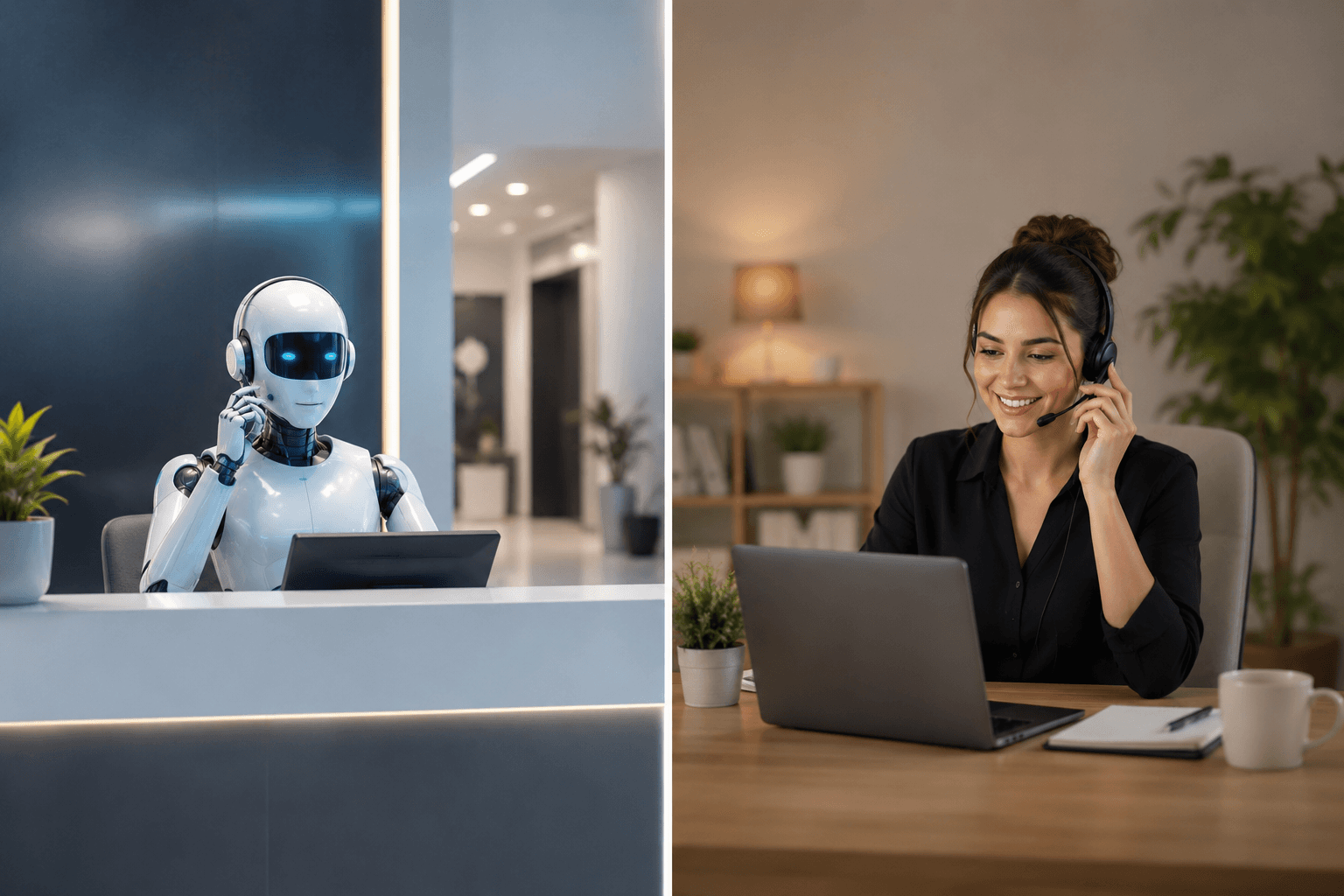
If you’ve been searching for a way to stop missing calls, you’ve probably come across three options: answering services, virtual receptionists, and AI receptionists. They sound similar but work very differently, and the right choice depends entirely on what your business needs.
Let’s break down each one so you can make an informed decision.
Traditional answering services
An answering service is typically a call centre with human operators who answer your phone when you can’t. They follow a basic script, take a message, and forward it to you via email or SMS.
The upside is that a real person answers the phone. The downside is significant: operators handle calls for dozens of businesses simultaneously, so they have no deep knowledge of yours. They can take a message, but they can’t book an appointment, answer specific questions about your services, or access your calendar.
Cost is usually €200–€500/month for a basic package, but charges per minute add up quickly. Most services charge €1–€2 per minute of call time. A busy practice taking 50 calls per day could easily spend €2,000–€3,000/month.
Availability varies. Many answering services operate during business hours only, which defeats the purpose for after-hours coverage. Those that offer 24/7 charge premium rates.
Virtual receptionists
A virtual receptionist is a step up. This is a dedicated remote worker (or small team) who acts as your receptionist from a remote location. They learn your business, can book appointments, answer FAQs, and provide a more personalised experience than a generic call centre.
The quality is much better than an answering service. However, you’re still limited by human capacity. A virtual receptionist can only handle one call at a time. If three patients call during your Monday morning rush, two go to voicemail.
Cost is typically €1,500–€3,000/month for a full-time virtual receptionist. Part-time options exist but leave gaps in coverage.
Language is another limitation. If you serve a multilingual market (common across Europe), you need a receptionist who speaks all the relevant languages. Finding a multilingual receptionist fluent in Italian, French, and English is expensive and rare.
AI receptionists
An AI receptionist uses artificial intelligence to handle phone calls in natural, conversational language. Modern AI receptionists like Emma sound human, understand context, and can perform complex tasks like booking appointments, answering detailed service questions, and routing calls based on urgency.
The key advantages are scale and availability. An AI receptionist answers instantly, handles unlimited simultaneous calls, works 24/7/365, and speaks multiple languages natively. There’s no hold time, no voicemail, and no busy signal.
Cost is typically a flat monthly fee, significantly less than a virtual receptionist. For most businesses, an AI receptionist costs €200–€500/month with no per-minute charges, regardless of call volume.
The technology has improved dramatically in the past two years. Modern AI receptionists don’t sound robotic or scripted. They handle interruptions, understand accents, and manage complex multi-step conversations naturally.
Which one is right for your business?
If you just need someone to take messages, an answering service works. If you need personalised service for a small number of daily calls and budget isn’t a constraint, a virtual receptionist is excellent.
But if you need to answer every call, in multiple languages, around the clock, without scaling your costs — an AI receptionist is the clear winner. This is especially true for businesses in Europe, where multilingual capability is essential rather than optional.
The question isn’t really which option is “better” — it’s which one matches your reality. If your phone rings 50 times a day in three different languages and you can’t afford to miss a single call, the only realistic option is AI.
Try it for yourself
Book a free demo at ringboost.ai and hear Emma handle a call in real time. You’ll understand the difference in about 30 seconds.