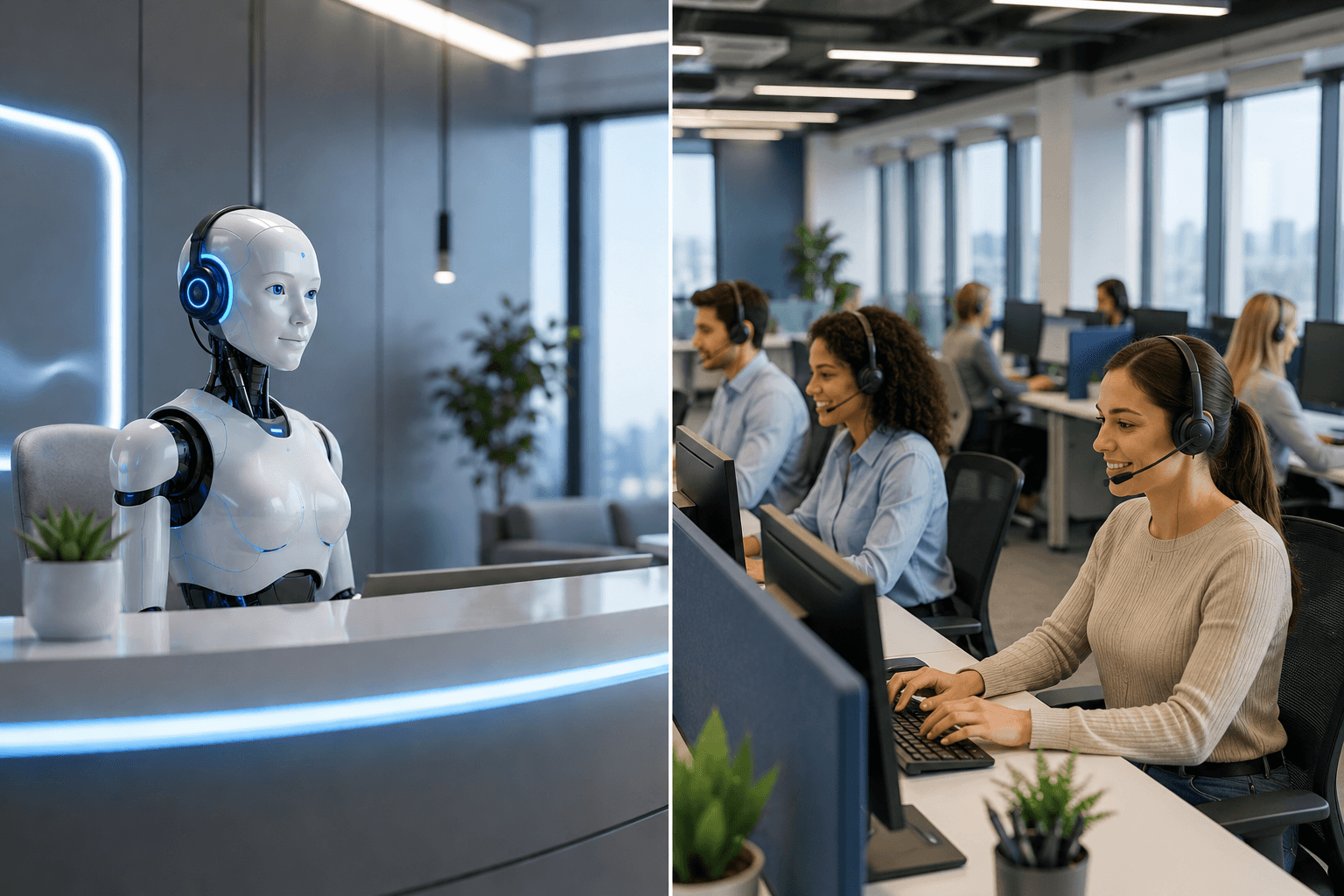
The outsourced reception industry has served European businesses faithfully for decades. From Dublin to Amsterdam, from London to Paris, companies like yours have relied on call answering services to pick up the phone when your team couldn't. Real people, sitting in call centres, answering your phone in your company name. It worked. For a long time.
But something has changed. And if you're still paying for a traditional answering service in 2026, it's worth understanding exactly what that change means for your business and your margins.
This isn't a breathless "AI will replace everything" article. This is a practical, honest comparison of two models, written for business owners who need to make a real decision about how their phones get answered.
The traditional answering service model
Here's how a typical outsourced reception service works. You sign up with a provider. They assign operators in a shared call centre. When your phone rings, it forwards to their centre. An operator answers in your company name, follows a basic script, takes a message, and sends it to you by email or SMS. Some services offer appointment booking, but most just take messages.
This model has real advantages. You get a human voice. The operator can handle unexpected situations. They can show empathy when a caller is upset. For sensitive industries like healthcare and law, there's comfort in knowing a real person is on the other end.
The problems, however, are structural and getting worse.
First, cost. A traditional answering service in Europe typically charges between 200 and 500 euros per month for a basic package. But that's misleading. Most services charge per minute on top of the base fee, typically 1 to 2 euros per minute. A dental practice or law firm taking 40 to 50 calls per day can easily spend 2,000 to 3,000 euros per month once per minute charges are included. An independent survey of answering service pricing found that AI receptionists cost 60 to 80% less than traditional services for equivalent call volumes.
Second, capacity. One operator handles one call at a time. Your Monday morning rush produces five calls in ten minutes. Four go to hold or voicemail. During peak hours, hold times increase and quality drops because operators are handling calls for dozens of businesses simultaneously. They don't know your menu, your treatment options, or your room types. They know a script.
Third, languages. This is where the model fundamentally breaks for European businesses. If you operate in the Netherlands, your callers speak Dutch, English, German, and Turkish. If you run a restaurant in Nice, your guests call in French, English, and Italian. If you have a hotel in Barcelona, you need Spanish, English, French, and German. Finding call centre operators who speak four languages fluently is expensive and rare. Most answering services offer one, maybe two languages.
Fourth, hours. Many answering services claim 24/7 availability. In practice, after hours coverage is either staffed by a skeleton crew with longer wait times, or is simply a voicemail service rebranded as "24/7 coverage." True round the clock human coverage with the same quality as daytime is prohibitively expensive for most answering service providers.
What has actually changed in 2026
The AI receptionist market has matured dramatically in the past 18 months. The technology that sounded futuristic in 2024 is now production grade. Modern AI receptionists don't sound robotic. They handle interruptions, understand context, manage complex multi-step conversations, and switch languages mid call.
Here is what an AI receptionist actually does differently:
It answers instantly. Not after two rings, not after a hold queue. Instantly. Zero seconds of wait time for your caller, whether it's 10am on a Tuesday or 11pm on a Saturday.
It handles 20 calls simultaneously. Your Monday morning rush? All five calls answered at the same time, each caller getting a personalised, professional response. No hold music. No "please stay on the line." No busy signals.
It speaks 30+ languages natively. Not through a language line. Not through a translation service. The AI auto detects the caller's language and responds naturally. If a caller starts in Dutch and switches to English mid sentence, the AI follows. This isn't a nice to have in Europe. It's essential.
It books appointments directly into your calendar. Not "I'll pass a message to the team." The AI checks your availability, offers slots, confirms the booking, and sends the caller an SMS confirmation. The appointment appears in your system immediately. No double bookings. No manual data entry.
It costs a flat monthly fee. No per minute charges. No surprise bills. No overage fees on your busiest month. For most businesses, an AI receptionist costs between 179 and 639 euros per month depending on call volume and features. That's for unlimited simultaneous calls, 24/7 coverage, and 30+ languages included.
The real comparison: what matters to your business
Let's get specific. Here's how the two models compare across the dimensions that actually affect your revenue and operations.
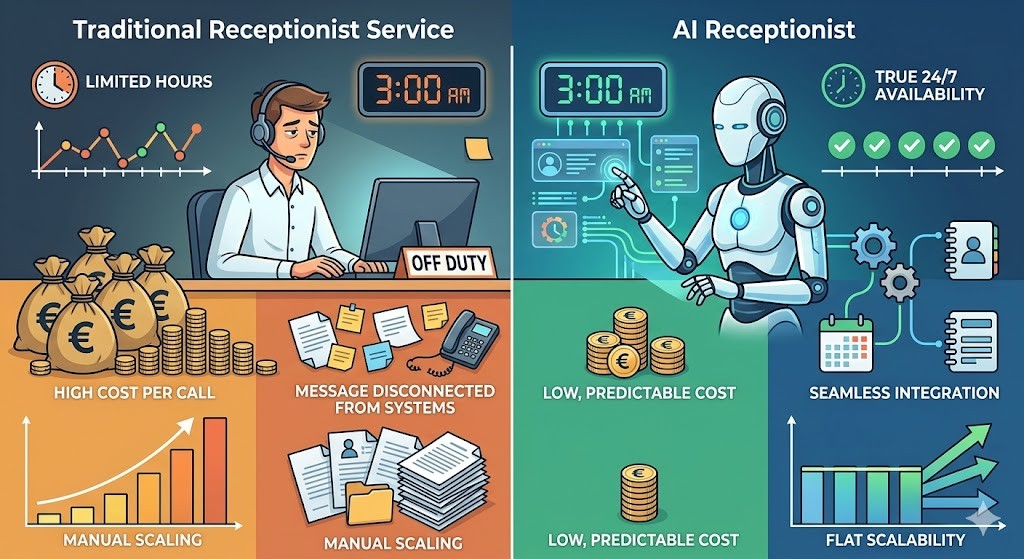
On availability, traditional services are limited to staffed hours with reduced quality overnight. AI receptionists provide identical quality at 3am as at 3pm. For businesses like restaurants (where reservations peak between 17:00 and 20:00), hotels (where international guests call at all hours), and clinics (where patients phone during their own lunch break, not yours), true 24/7 is the difference between capturing revenue and losing it.
On cost per call, a traditional service handling 500 calls per month at an average of 3 minutes per call costs roughly 1,500 to 3,000 euros per month. An AI receptionist handling the same volume costs 179 to 399 euros per month. The gap widens with volume. At 1,000 calls per month, the traditional service might cost 3,000 to 6,000 euros. The AI stays flat.
On consistency, this is one of the most underrated differences. A human operator's performance varies by time of day, day of week, how many calls they've handled that hour, and whether the operator who answered your last call is the same one answering this one. An AI receptionist delivers identical quality on every call, every time. The greeting is always right. The information is always accurate. The follow up always happens.
On integration, traditional services are disconnected from your business systems. They take a message and forward it. An AI receptionist integrates with your calendar, your CRM, your booking system, and your practice management software. When a patient books a dental appointment through Emma, it appears in your schedule immediately. No one on your team needs to manually enter it.
On scalability, this is where the model diverges completely. If your business grows and call volume doubles, a traditional service doubles your bill. An AI receptionist handles the increase within the same plan, or moves to the next tier at a predictable, incremental cost. There's no hiring, no training, no ramp up period.
Where traditional services still have an edge
Being honest: there are situations where a human operator is genuinely better.
If a caller is in genuine emotional distress, a complex family law situation, a medical emergency, a bereavement, a human operator can provide empathy that AI is still learning to match. This represents a small percentage of calls, typically under 5%, but they are important calls.
For businesses where the phone experience is part of the premium brand proposition, such as high end concierge services, luxury private banking, or exclusive members' clubs, a live human voice may be part of what clients are paying for.
But here's the nuance most answering service providers won't tell you: the best approach in 2026 is hybrid. AI handles the 95% of calls that are routine: bookings, enquiries, information requests, scheduling, and FAQ. Human operators handle the 5% that require genuine empathy, complex judgment, or the premium human touch. You get the cost efficiency of AI with the quality safety net of human escalation.
Emma does exactly this. She handles the routine calls and intelligently escalates complex or urgent situations to your team with full context already captured. The caller never needs to repeat themselves.
The market is moving. Faster than you think.
If you're running a business in Ireland, the UK, the Netherlands, France, or anywhere in Europe, and you're still relying on a traditional answering service, here's what you need to know: your competitors are switching.
The numbers tell the story. AI receptionists are growing faster in Europe than in any other market, driven by the multilingual requirement that makes traditional services prohibitively expensive. A traditional answering service that covers Dutch, English, German, and French would need four sets of trained operators. An AI receptionist covers all four (and 26 more) at the same cost.
Traditional answering service providers see this. The smart ones are already exploring how to integrate AI into their offering. The ones that don't adapt will find it increasingly difficult to compete on price, capability, and availability against AI alternatives.
This isn't about technology for technology's sake. It's about the economics. A dental practice paying 2,500 euros per month for a call answering service can switch to an AI receptionist at 249 euros per month and get better coverage, more languages, and direct calendar integration. The savings fund themselves several times over.
What about GDPR?
Any business handling calls in Europe needs to consider data privacy. Traditional answering services process personal data through human operators, which introduces risks around data handling, staff training, and compliance monitoring.
RingBoost AI is a European company, fully GDPR compliant, with data processed within the EEA. All conversations are encrypted, data retention policies are transparent, and a full Data Processing Agreement is available. Emma processes only the information necessary for the task at hand, whether that's booking an appointment or routing an urgent call.
Making the switch
If you're currently using a traditional answering service and considering a move to AI, the transition is straightforward. Emma connects to your existing phone number. Your number doesn't change. Your callers notice nothing except that someone always picks up.
Setup takes approximately 72 hours. During that time, Emma is trained on your specific business: your services, your pricing, your FAQs, your calendar, and your escalation preferences. Once live, she handles calls immediately with no ramp up period.
You can run both services in parallel during a transition period if you prefer. Forward calls to Emma during specific hours or for specific call types, and gradually expand as you build confidence. Most businesses complete the full transition within two to four weeks.
The bottom line
Traditional answering services were the best solution available for decades. They solved a real problem: businesses couldn't answer every call, and voicemail wasn't good enough. The people who built these services deserve credit for that.
But the technology has caught up. AI receptionists in 2026 offer better availability, better consistency, better multilingual capability, better integration, and dramatically better economics than the traditional model. For European businesses operating across languages and time zones, the advantage is overwhelming.
The question isn't whether AI receptionists will replace traditional answering services. That transition is already happening. The question is whether your business will be early enough to benefit from the cost savings and improved caller experience, or late enough to be playing catch up.
Book a free demo at ringboost.ai and hear Emma handle a call in your industry, in your language, in real time. Then compare that experience to your current answering service. The difference speaks for itself.